Thursday, November 10, 2016

Help, we're in a national crisis!

Students walking out of classes, protesters in the streets of our major cities, a renewed movement in California to secede from the union, petitions to the Electoral College, and continued angry exchanges in all forms of media.  Yikes!  I took a break from it all today to walk by the ocean here in Baja California and to reflect. These thoughts came…

From years of teaching crisis theory as part of Psychiatric/Mental Health Nursing, I know this:  Crisis is an OPPORTUNITY…to learn, to grow, to be strengthened.  We as a nation can come through this to a better place..  But three things are needed to help this happen:
  1.  An accurate perception of what is happening.  It takes some reflection to figure this out, and you may not agree with me.  I don't want to oversimplify, as the issues at hand are complex.  But my perspective is that we are getting a needed look at the ugly underbelly of racism in America, and at the deep fear of many of us white folks that things have been/are going to be taken away from us.  Donald Trump "played" to those fears in various ways, and those who voted for him were predominantly white people 45 and older.   I'm skipping the issue of abortion for now, though it played a big role in the vote among some Christian voters.  We have this opportunity to take a deeper look at ourselves and at the ways racism manifests itself among us, hard and uncomfortable though this may be.  
  1.  Support from others.  We need to be with others who care about us during a crisis.  I learned about Pantsuit Nation from some FaceBook friends.  It's a coalition of mostly women who supported Clinton and the values she has espoused throughout her decades of public service…namely the protection of civil rights and support for children, women and families.  These women (I'm linked with the Colorado Chapter, since most of my working career was spent there) are networking and reaching out to each other and to vulnerable people in their communities.  Find support with someone(s) you trust.
  1.  Good coping skills.  We've got to take care of ourselves, keeping a balance between work and rest, engagement and disengagement.  Some of us feel called to be advocates for something or other.  It's not a time to put our heads in the sand (at least I can't do this), as many people are hurting and afraid, and need support.  And many feel their most cherished values are at stake and are now determined to fight in every way possible for them.  But we can't do everything.  Media can become all consuming, and we should take breaks from that too.  We need comic relief, but not at the expense of others. 
My three cents…these three points.  We'll get through this.  Let's keep talking to and helping each other!

Saturday, October 15, 2016

Sa Bondye Sere Pou Ou

Sharing this draft of another book in progress...

Introduction

Sa Bondye sere pou ou lavalas pa janm pote-l ale.  What God has laid up for you, even the flood cannot carry it away.  
     Haitian Kreyol saying

Floods have carried away so much from those you will meet in this book:  women of Gonaives, Haiti.  They and their compatriots live in the pathway of hurricanes, near mountains too denuded to absorb heavy rains.  Their government, chronically disabled by complex forces, struggles to rebuild following disasters.  After the earthquake of 2010, these women welcomed and assisted refugees from Port-au-Prince, depleting their own meager resources even further.  And yet they have carried on, drawing strength from their faith and from each other.

The 2013 book, In the Company of the Poor: Conversations with Dr. Paul Farmer and Fr. Gustavo Gutierrez, shares words on faith and fortitude written during the 1500s by Teresa of Avila.  It happened to be a time when Teresa's countrymen were extracting riches from the island they’d named Hispaniola and importing diseases that nearly extinguished the indigenous Taino population, who called their home Ayiti, meaning "land of high mountains."  

No stranger to suffering, Teresa aptly describes the women of Gonaives when she writes of a “...determined resolve not to halt...whatever may come, whatever may happen to them, however hard they may have to labor, whoever may complain of them, whether they reach their goal or die on the road...whether the very world dissolves before them.”  

The women of Gonaives watched their world dissolve twice in the past decade.  I began to know them just months following the first "dissolving"…the devastation caused by Hurricane Jeanne in 2004.  I'd made earlier trips to Haiti, felt overwhelmed, and then--for awhile--resistant to having anything to do with the country.  But the women of Gonaives drew me into their fellowship in a way that eventually changed the course of my own life.  

Friends, Haiti, from L: Elisabeth, Sally, Miguelita,
Joselia, Elmide, me, Examene
Over the past 10 years I've watched these remarkable, resilient women build an ever stronger sisterhood of faith, take advantage of generously offered outside help to start their own cottage industry, and support efforts to improve the health of their community.  In January 2014, artist Sally Lincoln went with me to Haiti to try to capture the spirit of the women of Gonaives on canvas.  Her portraits are the centerpiece of this book.  All proceeds from book sales will aid cervical cancer screening and treatment for Haitian women, who have the highest rates of this preventable cancer in the world.

Chapter One:  June 1999:  Can We Cope? 

The sounds of lapping water upon a shore slap gently on my ear…an unfamiliar arousal.  Rolling from side to back, I sink into a sagging mattress, squeaking the springs of my metal bed.  Pale light filters through folds of mosquito netting while I puzzle--blinking, barely awake--at the presence of two women slumbering in nearby beds.  
     My eyes close again, but crowing cocks mock my desire for further sleep, and I remember with vague irritation that the lead rooster started up at 3:30 a.m.  And then, soon afterwards…the screeching of an animal…a goat, perhaps, being slaughtered?  Shuddering, I'd pulled the thin white sheet over my bare legs and shoulders, and dozed on.  
     Now, with sunlight warming the room, I sense the stickiness of sheets against my skin.  Accustomed to the pleasant dryness of Colorado's heat, I kick off the cloying cover and remember…I'm in Haiti, within yards of the Caribbean Sea.
     Last evening, sitting with friends under almond trees on a small terrace by the sea, watching an orange sun sink beyond the water's deep blue horizon and then later--in the darkening sky--a lightening display over distant Port-au-Prince, I began to understand the meaning of the moniker Magic Haiti.  But now experiences of the past 24 hours crowd my mind, and I wonder if we can cope with this place.  
  If last night is a predictor, we'll not be sleeping well.  Prior to the animal noises, I and my roommates wakened at midnight to the sounds of sobbing on the other side of the cement block duplex where the women of our service team are staying.  
     "I'd better investigate," I said, embracing my role as resident nurse.  
     Unlocking a solid wooden door, I pushed open a flimsy outer screen door--screen detached--and with flashlight, followed a narrow path around the building.  Gravel and small seashells crunched noisily under my flip-flops, sending several hermit crabs scurrying sideways into the darkness.
     The next-door room was just as airless as our own.  Beneath a heavy, army-issued mosquito net on a lower bunk, one of the women had become claustrophobic.   
     “She said she couldn’t breathe,” reported a helper supporting her whimpering friend under a cooling shower.  “We’ll move her to an upper bunk closer to a window.”

The Episcopal Church retreat center in Montrouis, a small, palm-fringed coastal town an hour's drive north of Port-au-Prince, revealed its challenges soon after our arrival.  Electricity and water supply will be intermittent.  But these seem like trifles compared to what we saw driving around the capital yesterday.  
     Not far from the airport, along the waterfront, hundreds of shacks made of flattened tin cans and cardboard stood cheek to jowl in one of few open spaces remaining in a city of (then) 2 million, originally built to accommodate 500,000.  During storms, as the water rises, inhabitants of those "shelters" stand, holding their few possessions--and small children--on their shoulders until the water subsides.
     Through the half open windows of our van wafted the acrid smell of burning refuse…gathered in pot-holed streets along which women crouched in the dirt selling vegetables and used clothing.  Clusters of barefoot children with stick legs picked at piles of garbage.  
     Families have flocked to Port-au-Prince from the countryside and the mountains in recent decades…seeking sustenance, hoping their leaders--or other sources--will deliver what they need: jobs, food, and access to healthcare.  Even following the 2010 earthquake that took 300,000 lives and injured another 300,000, many Haitians apparently still believe it best to be close to the places of power and delivery points for foreign aid.
     Of all we saw in the capital, the cart men seemed most symbolic of the struggles of Haiti…sinewy, barefoot, straining and sweating under the weight of concrete block-laden carts, climbing impossibly steep hills, step by steady step. Their life expectancy is about 40 years.  

A few days after arrival, we take a break from painting and carpentry work and travel to the northern port city of Gonaives to visit another Episcopal church and school.  Just beyond Montrouis, thick groves of banana trees press so close to the road that an outstretched passenger's hand could brush a huge leaf.  And then a yielding to wide landscape of rice planting and harvesting, dotted with muscled black bodies bending to their work, and white egrets winging through azure sky or resting on a far-flung patchwork blanket of green. 

These fertile fields of the Plaine de L’Arbonite supported the small-scale agricultural efforts of 50,000 Haitians up until the beginning of the U.S. occupation of Haiti in 1915, when the land was expropriated and handed over to American businesses. Displaced Haitians were forced to make a living elsewhere.   Some farmers of the plains moved into Haiti’s northern mountains while others migrated to the Dominican Republic to earn a pittance on sugarcane plantations…brutal work that for many would eventually turn deadly. Just two decades later, in 1937, an estimated 15,000 to 20,000 Haitian migrants—men, women, and children—were systematically slaughtered by direct order of President Rafael Trujillo of the Dominican Republic.  Haitian writer Edwidge Danticat’s award-winning novel, The Farming of Bones, offers a haunting vision of a massacre fueled by ethnic hatred.                                                 

The vibrant colors of the rice fields fade away as we approach what must be one of the most desolate parts of Haiti, aptly named Savane Desolee (desolate savanna).  It's like a moonscape…bare, rocky hills, speckled here and there with the remains of dead trees and bushes.  Only the occasional wiry cactus plant relieves the brown monotony.  
     "How can a tropical island look like this?" I implore our Haitian guide.  
     "The French colonizers felled and shipped tons of mahogany to Europe," he says, "so the mountainsides were exposed, and over many decades the heavy rains we get here have washed away the topsoil." 
     Continued degradation of the land, he explains, is largely due to non-stop cultivation by Haiti’s subsistence farmers (70% of the population), and to the use of trees for making charcoal—Haiti’s primary energy source.  
     Our van bounces and shakes over a tortured ribbon of dirt and rocks, and we see--through a haze of dust--the rusted, mangled remains of vehicles whose usefulness ended here, along with, no doubt, the lives of passengers.  Did anyone mark their passing in this no-man's-land?
     Our drivers, and others--some behind the wheels of new Toyota vans sporting spiffy non-governmental organization logos--careen from one side of the road to the other, seeking uncommon stretches of level ground.  Choking on billowing clouds of pale dust raised by the heavy traffic, we roll up windows, but the dust seeps in through the floorboards.  
     We barely miss a run-in with a large, lumbering truck carrying men, women and children---sitting atop crates and over-stuffed bags of food and charcoal.  With shirts and blouses pulled up around their mouths and noses against the dust, they appear as ghosts, in a lifeless landscape.  I struggle with a rising anger that anyone should have to travel under under such conditions...as though they were a commodity.

A little history:  The road to Gonaives was once a good road (and will be again following the 2010 earthquake when money will come to Haiti for a variety of projects).  Haiti had 1200 miles of well-constructed, all-weather highways by the end of the U.S. occupation (1915-1934).  Railways also connected north to south, and serviced other areas, but were dismantled and sold by "Papa Doc" Duvalier, the iron-fisted physician/voodou priest who ruled from 1957 to 1971, aided by his secret "police," the Ton-Ton Macoutes, whose deeds were as dark as their signature sunglasses.
     During a spurt of international aid following Papa Doc’s death, roads were repaired, improved.  But not so the road to Gonaives.  Some Haitians expressed the belief --during the early 2000s--that their leaders had purposely allowed the road to deteriorate, as a deterrent to political dissidents traveling from the north to Port-au-Prince.  Gonaives—Haiti’s second largest city by 1999 estimates (population then around 200,000)—was the seat of the slave revolt that spawned independent Haiti in 1804, and continues to be a place of political foment where demonstrations are common.  

The streets of Gonaives are shared by pedestrians, cart men, motorcycle taxis bearing women with shopping bags, a few donkeys, and Haiti's famous tap-taps…canopied trucks colorfully embellished with painted mottos, flowers, and religious symbols.  The tap-taps are crammed with passengers…some of whom literally hang out the open backs--secured by the hands of fellow riders.  
     Honking horns, the whine of traffic, and hundreds of street voices shouting greetings or curses--we know not which--rumble around us.
     “Keep your doors locked and windows at least halfway closed,” warns our Haitian driver.  
     Near the city center, we pull into a walled compound housing the Episcopal church and school.  Stepping out onto a large, rubbled courtyard, we dust off our cloths and stretch legs and arms stiffened by the journey.  A older man with a gap-toothed smile closes the tall metal gate.  This place feels like sanctuary. 
     A middle-aged, balding man wearing a black clerical collar with a short-sleeved grey shirt, approaches with a smile.
     "Welcome to Gonaives.  I am Pere (Father) Simpson."  
     The local priest and administrator of the school seems reserved, perhaps a little sad, but he shakes our hands with firm grasp and then introduces us to the school principal--a tall young man impeccably garbed in suit and tie.
     "I'll show you the bathroom," offers Pere Simpson, "and then we can take a tour of the school."

Located just off Independence Square, the school--formerly a jail—is a dark, depressing, two-story structure with uneven cement floors and bare walls.  Some 200 students  (pre-school through 8th grade) brighten the place with their blue uniforms and ready smiles. As we peek inside their classrooms, adorned only with old blackboards, they stand--some shyly, some smartly--behind rickety wooden desks, at the behest of their teachers, to say good morning.
     "Churches and other humanitarian groups run most schools in Haiti," says Pere Simpson, " but only about half of Haiti’s children attend school.  Many families can’t afford fees and uniforms."    
     Most of the teachers are men, but I notice a few women around the school.  One sits at a desk just off the principal's office, busy with paperwork.  She looks up and smiles as we pass the office.  Five years down the road, this woman will become my friend and invite me to collaborative work in Haiti.   
     A couple other women prepare food in the school's kitchen, a 3-sided cinder block shelter adjacent to the school.  Charcoal fires add to the heat in the airless enclosure where they sit on low stools between two huge aluminum pots, stirring rice and beans--midday sustenance for students, and likely the only meal of the day for many.   These women will become members of a group that will work to improve the future in tangible ways for themselves and their children.

Thursday, October 6, 2016

Strong Women and Gentle Men


Banana grove romance: Lewis Steckley and Elizabeth G. Engle
Macha Mission, Northern Rhodesia, c. 1914
Years ago I outlined a book--Mom’s Adventures in Africa--for my young sons.  I scribbled off a dozen chapters with titles like Python on the Road, Giant Rat Invades the Hospital, Crossing a Crocodile-infested River, etc.  My writing goals soon changed, however, as something else took hold of me: interest in the lives and times of relatives who had also lived and worked abroad.  

Perhaps the deaths of family elders, or my own aging, urged me on.  I interviewed my parents, aunts, uncles and others, studied family genealogies, took notes on books/articles written by or about my relatives, and read histories of Africa, India, Japan, and Mexico.  Deeply inspired, I wrote and rewrote, at one point scrapping detail such that son Owen, then a young teen, said: “You might be taking things out that people would find interesting, Mom.”

I also did some math, and found myself numbered among 40 individuals (including spouses) who spent more than 900 combined years in missionary work—mostly in southern Africa—during the past century.  Represented were 6 of the 8 branches of my family tree of recent generations: Engle, Raser, Frey, Lady, Lehman, and Nissly.  Most worked under the auspices of the Brethren in Christ (BIC) church, a small denomination with Anabaptist roots.

The stories of my relatives emerged upon the colorful backdrop of the upheavals of the British colonial and post-colonial eras.  Those arriving in Africa in the late 1800s took up the vision of David Livingstone.  One received a land grant directly from the hands of fanatical empire builder Cecil Rhodes (a sore point for the Africans, whose lands were taken!).  A relative in India visited with Gandhi.

Some of my missionary relatives, Southern Rhodesia, 1924:  Steckleys center back, with (from left) grand aunt Naomi Lady and son David, great grand uncle Harvey Frey, wife Emma and daughters Mabel and Lois.
Non-related, at far right Emma and John Climenhaga with Arthur, David, and Joel, and Mary Elizabeth Heisey
Life was not easy, and some died abroad. In Africa and India—where malaria and smallpox were rampant—several lost their lives to disease.  One died after being mauled by a lion (see previous post), another from a gun accident.  But from the mire of loss, pain and deprivation, bubbled up joy...joy found in service, relationship, and meeting the challenges of dangerous, but beautiful frontiers. 

With housemates Mettie Hutten (L) and Shirley Heisey (R),
Silisi Cottage, Macha Mission, Zambia, 1976
Strong Women and Gentle Men is a book in progress. It needs more African perspectives. Meanwhile...this second blog in honor of the recent 100-year anniversary of Sikalongo Mission, Zambia (formerly Northern Rhodesia). Numerous relatives worked at Sikalongo, and at nearby Macha--my own home from 1976 to 1978--where this story begins.


Nursing students, Macha Mission, where I served as Sister Tutor 1976-1978

The banana grove, Macha Mission, c. 1914: my great-grand aunt Elizabeth Engle, right, with Lewis Steckley, her husband-to-be, and widow Sallie Krieder Doner, whose personal history was a reminder of the perils of Africa.  Sallie’s husband succumbed to malaria in 1911; he had lost his first wife to the infection in 1904.

Faith and a “call” to serve may have mitigated fears of disease and death, but saying farewells to loved ones who might not be seen again this side of heaven?  Wrenching.  “The partings were like funerals,” said a former missionary.  Aunt Elizabeth parted from parents and three siblings in Kansas in 1907, arriving in Southern Rhodesia at age 31.  She would not see her family again for 9 years.  

But love awaited her.  A canopied path beckons in the photo.  Did Elizabeth and Lewis ever walk that leaf-strewn carpet hand in hand, pondering the future, wondering how many years they would have together?  If only trees could talk!  The same grove shaded me 6 decades later when I came to Macha to teach nursing at age 24--full of purpose and dreaming of romance.

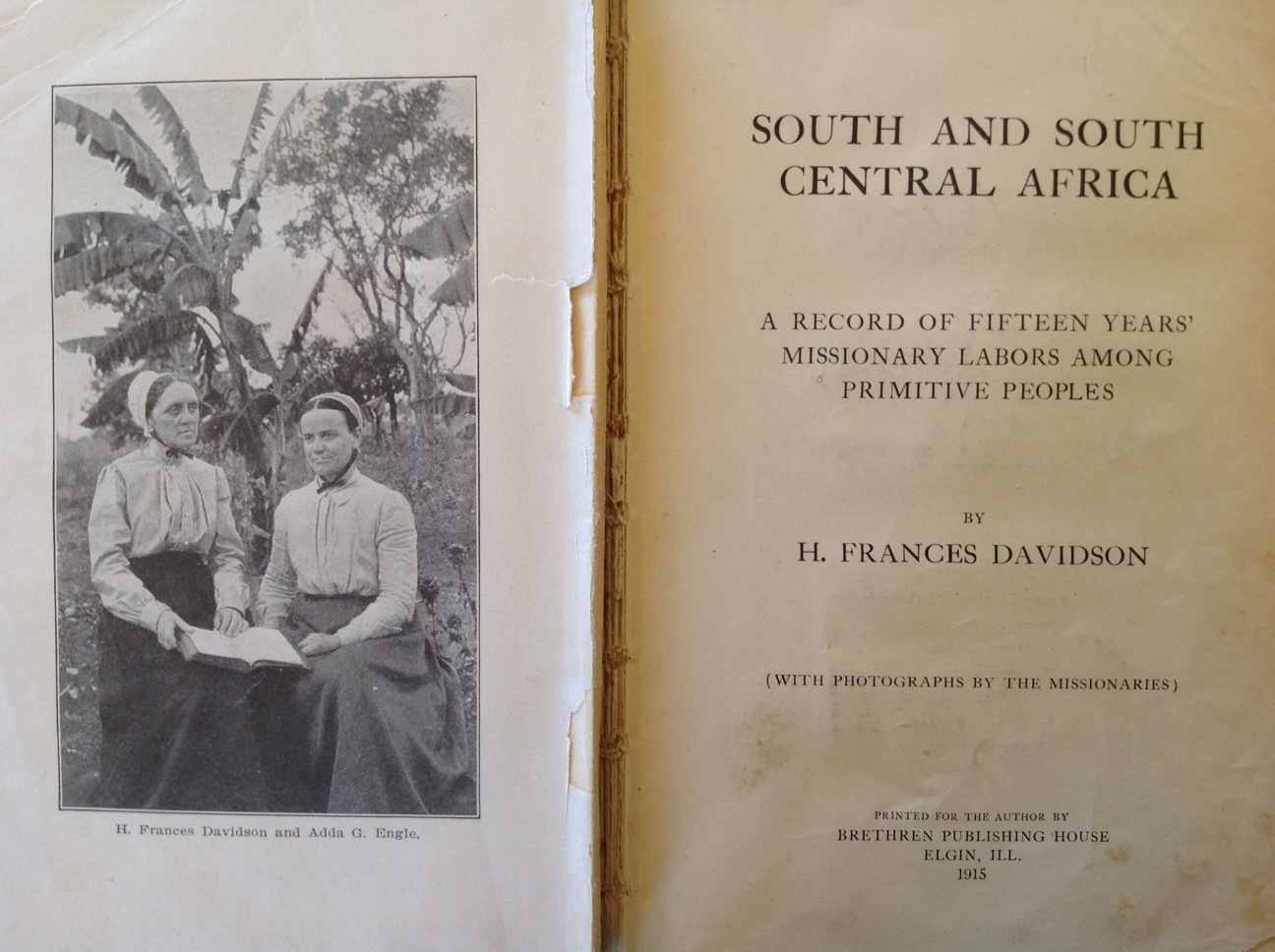
Photo from Frances Davidson's 1915 book, South and South Central Africa
Elizabeth was the first trained nurse at Macha.  She’d done basic practical nursing at home, but soon learned much more.  She delivered babies, set broken bones, and stitched up gashes caused by the slip of an ax or the goring of an ox.  Frances Davidson, who co-founded Macha in 1906 with Elizabeth’s cousin Adda Engle (previous post), wrote of a chief’s son “badly mauled by a leopard,” noting that Elizabeth “very successfully treated his wounds.”

And Lewis?  His grandniece Rhoda Marr wrote recently: “My mom was only a little girl when Lewis left home [in Ontario, Canada, at 28] to be a missionary. He was oldest in the family of 14 and she was next to the youngest. She...remembered him as being the quiet, studious one of her many brothers and her parents had mixed feelings about him going to the other side of the world and yet were pleased that he was following God's call.”

Elizabeth's parents Jeremiah and Susan Gish Engle;
Jeremiah died 6 weeks after Elizabeth's Nov. 1916 wedding
What drew the couple together?  Both came from farm families who were committed members of the BIC fold.  Lewis was the son of a bishop and Elizabeth the younger sister of one--my great-grandpa Millard Gish “M.G.” Engle.  Lewis arrived in Africa several years after Elizabeth.  He was 30 and she 36 when, in 1913, they traveled from Southern Rhodesia to Macha, working there together for 3 years.  They wed November 9, 1916, at Elizabeth's parental home in Abilene.

1925 finds the couple at Sikalongo Mission, where they served alone until 1928.  African Jesse Cikaile was their faithful helper.  Church, school, and medical work continued, and the Steckleys also did landscaping and got out and about.  In a letter to the BIC church magazine (Evangelical Visitor, June 21, 1926) Elizabeth wrote of a ~ 40-mile round trip visit to a student’s village.  Leaving just after midnight, they traveled “as far as my husband’s road repairing camp where we were given a fresh yoke of oxen and a new driver [and] after a cup of hot tea all around, we continued our trek.”

 Trekking near Macha Mission, c. 1913, as Aunt Elizabeth prepares to take on supervision of village schools,
photo from Davidson's South and South Central Africa
It seems Elizabeth loved to trek.  She wrote in 1920, from Southern Rhodesia, of a week-long visit “among the village people about 5 miles north of Mtshbezi Mission.”  She and Lewis stayed in a grass hut “which was quite comfortable,” and held services around campfires in the evenings. “Some expressed their regret that we had to leave so soon,” she shared, and: “Let us pray that God may raise up some good native workers, or someone to do evangelistic work in other villages, which are so much neglected.”

"They were very reserved," was the common response from numerous relatives I interviewed about the Steckleys. Yet letters penned to the Evangelical Visitor by the couple reveal lively spirits.  Farming blood in their veins, they often mentioned planting and harvest…and gratitude in the midst of hardship.  From Matopo Mission in 1923, Lewis wrote of drought and famine and sharing what they had with African staff and villagers.  “Our hearts swell up in praise to our heavenly Father for his loving care over us, and for all he has done for us we will never cease to love Him.” 

A mission historian wrote this of Lewis in 1950:  “Although a man of few words, no missionary has lived a more consistent life than he, and none excelled him as an industrialist.  He was a careful worker and a good financier...uncomplainingly he went wherever he was most needed.  And with him, just as uncomplainingly, went his noble-minded wife...”

Visiting cousin Mary Newlin in Abilene, Kansas, 2012
Noble-minded Elizabeth read literature and poetry aloud to the single missionaries when the Steckleys occupied the main house at Matopo Mission in the 1930s.  “She read while they ate so they wouldn’t gossip about their African students,” said Elizabeth’s missionary niece Mary Engle Newlin.  And during those early years there were other boundaries: “The only Africans to enter missionary homes were servants,” said Mary, “but Aunt Elizabeth served tea on the back stoop and did mending; she had a very soft place in her heart.” 

The Steckleys retired in 1941, and settled in Kansas amid a passel of Engle relatives.  “Uncle Lewis was one of my favorites,” said Mary Newlin.  And he was still living in Abilene, aged 93, twice a widower, when I passed through in the summer of 1976, the year prior to his death.  Having just completed a master’s in nursing in Ohio, I was headed home to Colorado to pack for Africa.  Grandma Minnie Lady Engle gave me a rug she’d made for me to take to Zambia, saying “the [cement] floors are cold.”  But she did not introduce me to Uncle Lewis, and I did not know of him to ask.  I'm so grateful for cousin Mary's memories, and the inspiration of her own life as a missionary in Southern Rhodesia and Sierra Leone, and later as a pastor in Kansas.  She was married and widowed twice.

Grandma Minnie Engle's 1976 gift,
for the cold cement floors in Africa
Grandma’s gift graces my living room floor here in Mexico.  And I have another treasure--Elizabeth’s steamer rug, a woolen blanket that warmed her on Atlantic crossings over 4 decades.  It came to me from cousin Mary, gifted to her by Aunt Elizabeth as Mary prepared for Africa in 1952.  “She saw that the local church had given me an amateurishly-made afghan that would not be adequate for the cold,” said Mary.

For a short while, a couple years before Elizabeth’s death in 1956, the Steckleys took Elizabeth’s brother M.G. Engle into their Abilene home.  He had just lost his second wife, was almost 90, and had led an illustrious life as bishop, evangelist, and long-time chair of the BIC Home Mission Board.  What did they speak of during those days?  Joys, regrets, the nearness of heaven?  Oh to have listened in…

Although I missed the chance to talk with Uncle Lewis, I spent some time in 1981 with Anna R. Engle (Elizabeth's second cousin), whose missionary efforts overlapped with those of the Steckleys. Then 85, Anna had spent half a century in Africa as accomplished teacher, translator, and author. “Looking back, would you have done anything differently?” I asked.  She paused for a few moments, and then said quietly, “I would have loved more.”

Aunt Elizabeth's steamer rug; perhaps she read Frances Davidson's recently (1915) published book
on the voyage back to Africa in 1918.  It contained stories and photos of Elizabeth…
something to share with her new  husband!

Quote about Lewis Steckley from Anna R. Engle, J.A. Climenhaga, and Leoda A. Buckwalter, There Is No Difference:  God Works in Africa and India (Nappanee, IN: E.V. Publishing House, 1950), p. 73.

Friday, September 16, 2016

Of lions, legends, and love


Myron with Africans, wife Adda and daughter Anna
Northern Rhodesia, circa 1925
His nickname was “Sia ku yasa mu liso,” meaning “the person who shoots (literally who spears) in the eye.”  Known for his legendary courage in tracking lions--those that preyed on local cattle--and his accuracy with a gun, Myron Taylor died on September 16, 1931, days after being mauled by a lion...”a victim of his own fearlessness and self confidence,” wrote a fellow missionary.

I’ve been considering Myron’s life on this 85th anniversary of his death, and seeing some small parallels in our lives.  I too went off to Africa as a young adult, moved by faith, with a sense of calling, and ready for adventure.  I’m less impulsive than Myron appears to have been, and my 64 years now give me a little more life experience than he, who died at 58.  But like him, my self confidence has perhaps not always served me well. 

Enjoying Victoria Falls, 1976

With students and colleague Mary Biser (L)
Macha Mission Nurse Training School, 1978

H. Frances Davidson (L) and Adda G. Engle, founders of Macha Mission
Linked to Myron through his wife Adda Engle, a first cousin to my great-grandfather, I lived and worked in the late 1970s where the couple first met--at Macha Mission in Zambia.  Adda Engle and colleague Frances Davidson founded the mission a year prior to Myron’s 1907 arrival in what was then Northern Rhodesia.  The two women had trekked 485 miles through the African bush, in spite of those who tried to discourage and block their venture.  “Their tenacity earned them respect and reluctant assistance,” said a beneficiary of the mission.


Map from Davidson's 1915 book, South and South Central Africa

Davidson called Myron the "long-looked-for-co-laborer."  He hunted game to provide meat for the growing mission population (a school had been started) and made bricks for building permanent, ant-proof houses.  It soon became clear, however, that Myron’s passion was outreach, and his departures on evangelistic journeys were often abrupt and sometimes ill considered, according to Davidson.  He traveled in the rainy season and suffered repeated bouts of malaria, coming close to death at one point.  

Within two years of Myron’s arrival, he and Adda were married.  Davidson wrote in her journal: "I am sorry to be separated from Sister Engle…as I have enjoyed her association as much as that of her intended has been a trial to me."  The newlyweds soon sensed a call to a new area, and they persevered through numerous setbacks and trials toward their goal.  

Mission house at Sikalongo
The Zambian Brethren in Christ Church celebrated, last month, the 100 year anniversary of the mission founded by Adda and Myron.  Sikalongo Mission brought education and health care to the Tonga people, along with the Gospel.  One of Zambia’s leaders in the struggle for independence from Great Britain was educated and nurtured at Sikalongo.

My own "native stool" acquired in Tongaland
The Reverend Peter Munsaka and Arthur Kutwayo of Sikalongo said this of Myron:  He “...sat on the native stools or on the same bench with local people.  He was among very few white people who prepared a ‘sit’ for the local people inside his house.  In most cases natives were to be met outside the house and spoken to there.”

What made Myron different?  Perhaps his own humble beginnings?  I interviewed the Taylor’s daughter Anna Taylor Grissinger in 2004 (aged 91, with a keen memory) and she shared this family history:

Myron, who grew up in the backwoods of Michigan and had an 8th grade education, was the great grandson of a English general.  The general's son took passage to the former colonies, settled in Detroit, married an American, and was disowned by his aristocratic family.  The young couple died in an influenza epidemic, and the general never came to know his grandson George.  

George Taylor fell in love with Sophia Neff, a young girl whose life with a alcoholic father prompted her to ask her husband to live where no alcohol was available.  So off to rural Michigan they went to raise a family of four.  The family met neighbors of the Brethren in Christ persuasion, and red-haired Myron, nicknamed Flammable, joined the local fellowship and soon learned of the church's new venture in the Rhodesias.  

Myron and Adda Engle Taylor with Anna (L) and Ruth


Myron experienced God's call to Africa in his late twenties, and spent the next several years preparing for mission work.  He made his way from Boston to Liverpool on a cattle ship, his berth in exchange for feeding and caring for the livestock.  He traveled from Liverpool to Cape Town by regular steamer and was soon headed to the African interior--to his mate, his work, his destiny.

Anna (L) and Ruth with their mother Adda


I wrote more about the Taylor family’s life in Africa, and about Myron’s death and its aftermath in the April 2016 edition of Brethren in Christ History & Life (bic-history.org Through the Eyes of a Child).   Though I’m a gatherer rather than a hunter, the eulogy at Myron’s death is worthy of aspiration, whatever blunders I may make on this earthly journey.

Physically, he hunted and brought us meat.
Spiritually, he hunted and brought us to God.
Please God, receive him in our tradition,
For he lived with us and loved us.


Black and white photos courtesy of Brethren in Christ Historical Library and Archives
Info on Myron's nickname from "Memories" by David E. Climenhaga 
Quotes and eulogy from Anabaptist Songs in African Hearts: A Global Mennonite History by John Lapp

Saturday, September 3, 2016

Mi Ranchito: Dust, Tears, and Hope

Washing machine tubs=septic system
"You live on a ranch; you have to be creative!" declared plumber Jaime, hoisting old washing machine tubs into holes dug to receive waste.  "The solids will stay in the bins and the liquids seep out.  These should be good for several years."  Learning from Jaime and others, my ranch manager/son Owen has recycled old items to make repairs, screen doors, and a workshop. He's also found his vocation: building and repairing guitars, and it's a joy to see his delight in the work and early success following weeks of study and preparation.


Owen and helper use old garage door for Owen's workshop


Owen repairing broken guitar neck


Two-year old Alex sometimes feeds goats through the fence


A ranch, by definition, has animals, and so far we have none. Just a small boy who sometimes acts like one. We could count the neighbor's horse who grazes on our weeds now and then, or the rooster that regularly flies over the fence. I balked at allowing the neighbor's goats to graze here, alongside a toddler. But one day a large billy goat, eyeing the green on our side from the barren field next door, jumped over a dip in the fence and quickly nibbled up some plants we were nurturing as dust barriers. "Goats will eat everything!" said Rosa, who grew up in rural country near Mexico's southern border.


Pepper tree a favorite spot for Aunt Lois and Rosa
"It was a paradise," says neighbor Lupita, of the hectare I lease in Baja California. "There were fruit trees of all kinds and beautiful flowers…years ago when water was plentiful." Owen and I came to the land a year ago, soon thereafter welcoming Aunt Lois and her caregiver/companion Rosa, with little Alex. We were pleased to inherit the hardy survivors of a half decade's neglect and drought: three large fig trees, a half dozen olive trees, several flowering bushes, lots of lilies, and a huge Peruvian pepper tree. One evening a gray-haired man in a pickup, unknown to us, showed up at our gate and requested pepper tree leaves for his sick wife.

Abundant fig harvest from 3 trees!


Trying my hand at brining olives


Hoping to slow the trucks that speed down our road; round
house is where Aunt Lois lives, her window away from the dust!
Agriculture enjoys water usage priority in the Baja, and the growth of large berry and vegetable farms seems to know no bounds. Daily, 5:30-6 am, buses carrying pickers roll by just yards from our homes, and later, trucks with supplies for building tents to protect the growing produce, and trucks to carry the produce away. Water trucks drive by too, sometimes wetting the dirt road. More often dust billows, covering everything and seeping into our houses.


Owen with neighbors Fernando and Loreto,
soon after we came to the land in September 2015
This past week neighbors Fernando and Loreto and I drafted a letter to the head of city government, requesting permission to built speed bumps on our road (27 of us signed the petition). And we talked of water woes. The city water flows about every four days (and costs about $4/month), but rarely fills cisterns completely. I'd recently called a man who sells from his private well, as no water had flowed for over a week and laundry was piling up! "It's expensive to buy," said Loreto, though the man charged half (about $22 USD) of what he'd asked six months ago to fill our cistern. Neighbor Lupita was visiting me when the water truck arrived this time, and I credit her presence with my getting a Mexican rather than a Gringo price!

Following our letter-writing session, Fernando gifted me with veggies from a relative's farm and Loreto with delicious marmalade she made from our figs. The friendship of neighbors in a new land is priceless to me, and I've now met everyone down the road, having made the rounds with the petition. "We also need to ask for street lights," said one woman. "Come to a surprise 70th birthday party for our father on Saturday," whispered the daughter of a large extended family that lives two ranches down. Beef sides hung along a porch…for the party, perhaps.

Neighbors Loreto and Fernando's field and house;
white tent for "surprise" birthday party just beyond the house

Six years in Africa prepared me to live with limited water, and work in Haiti, with dust and delays. I thrive on most challenges. But nothing prepared me for the rending of my marriage--a union of three decades, imperfect but precious. I now understand why divorce is called a "living death." This rugged new terrain has been watered with tears…many shed alone, some with other women--befriended at my kitchen table or the women's shelter--who are also struggling with family pain. Sustained by the love of our sons and faith that God is working in all, I'm enormously grateful for the emotional support of a small circle of faithful family members and friends.

Shelter women here for a Mother's Day celebration


Meanwhile, I've been on a quest to understand more about childhood trauma and its impact on my family, our extended families, and others. During a recent camping getaway with Owen and neighbor/friend Lupita, I had some quiet hours for reflection and experienced a kind of epiphany, recognizing similar patterns of behavior among family members who experienced trauma as children.
Quiet camping spot amid vineyards of Valle de Guadalupe


I've studied, taught, and written (published) about trauma in recent years, yet failed to fully understand the trauma dynamics operating in my own family. I was too close to it all, and coping with my own pain of rejection.

With friends during a getaway in Valle de Guadalupe

I just ordered After the Tears: Helping Adult Children of Alcoholics Heal Their Childhood Trauma, but have already learned from other reading that traumatized children, as adults, tend to perceive assertiveness in others as anger or threat, and to isolate themselves when feeling anxious or fearing loss of control. The million dollar question is this: in times of disagreement or conflict, how does the assertive person who values emotional honesty, direct communication, and accountability relate to the traumatized person--whether spouse or friend or workmate? The short answer is to make accommodations for the sake of love, while supporting the healing of trauma in those ready to seek it. Herein lies hope.  I'm still learning, and welcome hearing your experiences.

Taken just after one of our rare, dust-settling rains!

Saturday, July 30, 2016

Music in the Air: Two Summers at Interlochen

The mid-summer heat in Mexico's Baja California is upon us, and given the continuing drought, we're rationing water as we wait our turn to have the cistern filled.  I need a mini-escape, and find joy looking through photos from Interlochen and reading my journals...

June 21, 2009

Melodies of Bach and Mozart float from wooden "practice" cabins nestled among tall pines.  The sweet sounds of strings and voices are punctured by percussion beats and jarred by jazz belted out on saxophones and trombones.  This joyous, competitive cacophony marks the Sunday before camp begins.  All around the 1200-acre Interlochen campus in northwest Michigan, students prepare to audition for ensemble placement, or coveted parts in plays or ballets.
Owen (L) and John 


As John (17) and Owen (18) explore, I relax on a shaded patio overlooking a tranquil lake.  Swimming and boating offer diversion from the grueling and sometimes driven efforts made here every June-August.  I'll learn more about overuse injuries when I work next summer as a camp nurse…and more about homesickness.  A half dozen teens lean over the railing near my chair, looking toward the lake, laughing and talking in Spanish. They're from Venezuela, Peru, and Costa Rica, happy to have found each other. 


John's cabin
Having helped John settle in, we head to lunch in the huge dining hall, fill our plates from a smorgasbord of food choices, and sit with students from Sweden and China.  Most of the 2000 campers---representing 40 countries--are now in uniform: navy corduroy shorts and white tops (white for Sunday; other days they'll wear blue).  Later today they'll line up to march into the massive, open-sided Kresge Auditorium for the opening ceremony.


High School girls ready for opening ceremony

Visionary high school music teacher Joe Maddy started summer music camps here in 1928.  Wealthy Chicagoan Clement Stone provided the funds to help it become the internationally renowned Interlochen Center for the Arts, comprising Arts Camp, Arts Academy (boarding high school), College of Creative Arts, Public Radio, and Interlochen Presents (performances by students and world-class artists).

Visiting graves of great-grandparents in Iowa, en route
His prior application rejected, John worked hard to make the cut this year.  I sense the parallels between the journey from Colorado to Interlochen and the journeys John and Owen have made over the past couple years…through adolescent trial and error into a growing maturity. Both have embraced the faith of their parents and grandparents, along with empathy and compassion for others.  My heart overflows with gratitude when John speaks of the boys he'll get to know in his cabin of 12, and says "I'll be reaching out to those who seem not to be fitting in."

Mid-way through camp, John writes to me and Bill:  "I can't thank you guys enough for making this possible for me.  I've grown and matured in many areas besides music, and consider this experience a major event in my life…"  John "was a constant source of inspiration for his peers," writes his jazz guitar teacher, welcoming John back for next summer.  

            ****************************************************************************************

July 2010
John meets my nurse co-workers


What joy to be back amid the music and the pines…for two weeks instead of two days!  My volunteering helps with John's tuition.  And it's a welcome break after a year of nastiness in the workplace and too little playtime.  I've developed hip pain recently and am blessed to have found a medical massage therapist here who's given me corrective exercises.  


Camp nurse colleagues in the boy's sick bay
At the boys' infirmary we deal with bites, injuries, homesickness, and general exhaustion...offering encouragement and a listening ear in addition to pills and lotions.  Most of the boys are fairly stoic.  There's more drama on the girls' side of camp, where I was called one evening for psychiatric nursing support.  So much pressure, often self-imposed, in spite of staff efforts to help students balance work and leisure.  I need that balance myself!


July 26:

Wine-tasting tour, Old Mission Peninsula
"Let's go to Poppycocks in Traverse City," says John, when I offer to take him out to eat soon after arriving at Interlochen.  Over yummy vegetarian food, he tells me about his teachers, new friends, and the delights of excelling on guitar and writing his own music.  Next day, in the staff cafeteria, an Arts Academy faculty member encourages me to investigate the Academy's postgraduate (post high school) year of study for John.  


July 28:  

I'm on a self-care getaway during my two-day break: another massage, hotel room with jacuzzi, walk by the lakeshore, and now a tour of wine country on the Old Mission Peninsula.  Lovely, relaxing!


August 1:

John with his proud papa
Sunday morning by the lake, I lean into my adirondack chair and listen to the music as various groups prepare for performances at camp's end.  Closing my eyes, I feel a deep peace as sounds of the Interlochen Chorale wash over me.  And later, listening to the orchestra play the second movement ("coming home") of Dvorak's New World Symphony, I sense the need to create more quiet moments for my spirit.

S.S. Badger, crossing Lake Michigan


August 9:

John checked out of Interlochen full of enthusiasm for the future, whether or not he's accepted for the Academy's postgraduate year.  He received the High School Boys division Honor Camper award, and commented, "It almost means more than a music award."  The final concerts by John and his jazz cohorts were inspiring!


Post Script:  Soon after John completed his postgraduate year at the Arts Academy, I left my stressful job and started my own consulting business.  John now attends seminary in Japan, and continues making music.  Owen, living in Mexico, has taken up guitar making.